
 Free download:
 In This Guide
- The mistake I watched cost my son his spot on the field
- Why pre-game nutrition works differently for teenagers
- The timing framework that changes everything
- What to eat 3–4 hours before the game
- What to eat 30–60 minutes before kickoff
- The foods that will hurt your teen’s performance (even the “healthy” ones)
- Real pre-game meal combinations by timing
- What to do when games are early morning, midday, or late afternoon
- The hydration piece most parents completely miss
- Free 1-week meal plan
This guide covers pre-game meals for teen athletes, what to eat, when to eat it, and why timing changes everything.
The Mistake I Watched Cost My Son His Spot on the Field
My son Liam has played soccer since he was six years old. He lives for it, the early Saturday morning drives, the post-game replays on the car ride home, the way his whole face changes the moment he gets on the field.
But there was a stretch in his sophomore year that I still think about.
He was working harder than he ever had. Extra sessions after school, watching film on his own, doing footwork drills in the backyard until the sun went down. And for the first forty-five minutes of every game, he was genuinely good. Fast. Sharp. Confident.
Then the second half would start and something shifted. He’d get slower. A step behind. He’d come off the bench looking frustrated and confused, like his body had made a decision his brain hadn’t agreed to.
His coach, a man I respect deeply, started substituting him earlier into the second half. He pulled me aside after one game and said something that was meant kindly but landed hard: “Liam’s got the skill. I just don’t know if his body can handle the full ninety yet.”
That night I went home and started reading everything I could find about youth athlete nutrition. Not because I thought Liam had a fitness problem. But because something in my gut said this was a fueling problem.
It was.
Liam had been loading up on protein before games: chicken, eggs, protein shakes, because that’s what he’d heard helped athletes perform. He was skipping or barely touching his carbohydrates. And he was showing up to games already mildly dehydrated from a school day with a half-empty water bottle.
He had the discipline. He had the talent. He just didn’t have the fuel.
The second half of that season looked completely different once we fixed three things: the composition of his pre-game meal, the timing of it, and his hydration leading into kickoff. His coach noticed before I even said anything. By the end of the season he told me Liam’s energy curve had become one of the most consistent on the team, start to finish.
This guide is what I wish someone had handed me before that conversation in the parking lot. If you want to go deeper than one article allows, everything I learned, the full framework, the meal combinations, the snack timing, the recovery habits, is inside the Raising Strong Athletes ebook. But start here.
Why Pre-Game Nutrition Works Differently for Teenagers
Before we get into the what and when, it helps to understand why this is a different conversation for teen athletes than it is for adult athletes or recreational kids.
A teenager playing competitive sport is doing two enormous things at the same time: performing at a high level AND growing. Bone development, muscle growth, hormonal changes, and brain development are all happening in the background of every training session and every game. That changes the fuel requirements considerably.
Adult nutrition advice often focuses on performance optimization, how to squeeze the last two percent of output from a well-developed body. Teen athlete nutrition has to do that AND support normal adolescent development. If the fuel isn’t there, the body will prioritize growth over performance, or worse, start pulling from reserves it shouldn’t be touching.
A few things that matter specifically for this age group:
Carbohydrates are not optional. Teenage athletes have significantly higher carbohydrate needs than adults because their growing muscles store glycogen less efficiently and their bodies burn through it faster during high-intensity sport. For soccer, basketball, lacrosse, or any sport with repeated sprint efforts, carbohydrates are the primary fuel. There is no effective substitute.
Protein is important, but timing matters more than quantity. Most teen athletes are not protein-deficient, they’re getting enough across the day. The mistake, like Liam made, is front-loading protein right before a game instead of spreading it through the day and prioritizing carbs pre-game.
The digestive system is under stress during high-intensity play. When your teen is sprinting, their body redirects blood away from the digestive tract to the working muscles. This means anything that’s hard to digest, high-fat foods, large amounts of fiber, or a very heavy meal, can cause cramping, nausea, or that heavy-legs feeling that shows up in the second half.
Hydration starts hours before the game, not at the bench. Mild dehydration, as little as 2% of body weight in fluid loss, measurably slows reaction time, reduces sprint speed, and impairs decision-making. By the time your teen feels thirsty at the field, they’re already behind.
The Timing Framework That Changes Everything
The single most useful thing you can learn about pre-game nutrition isn’t what to eat. It’s when.
Every meal and snack serves a different purpose depending on how far away the game is. Here’s the framework I use, and the one built into the Game Day Fuel Toolkit from Raising Strong Athletes:
P1–3 (1–3 hours before): This is the main pre-game meal. The goal is to fill your teen’s energy stores, include a moderate amount of protein for steady energy, and keep fat and fiber on the lower side so digestion is comfortable. This is the most important window and the one most families get wrong.
P30 (30–60 minutes before): This is the quick top-up. Something small, easy to digest, and carbohydrate-forward. Not a second meal, just enough to top off the tank without anything sitting heavy in the stomach.
DUR (during play, for sessions over 60–75 minutes): If the game or session runs long or conditions are hot, carbs and fluids during play matter. Relevant for soccer, lacrosse, basketball, sports with extended continuous effort.
POST30 (first 30 minutes after): Recovery starts the moment the whistle blows. This is the window for carbs plus protein to kickstart muscle repair. Covered more in the recovery section.
The key principle across all of these: the closer to game time, the simpler and smaller the food.
What to Eat 3–4 Hours Before the Game (The Main Pre-Game Meal)
This is your primary fueling window. Your teen has time to properly digest a balanced meal, which means you can include all three macronutrients, but you’re building the plate around carbohydrates, not protein.
The pre-game plate at 3–4 hours out looks like this:
- ½ plate carbohydrates (the biggest portion)
- ¼ plate lean protein (moderate, not oversized)
- ¼ plate vegetables or fruit (cooked or gentle, not a massive raw salad)
- Small amount of healthy fat (olive oil, avocado, keep it light)
- Water with the meal
Why carbohydrates take up half the plate: Muscle glycogen, the stored form of carbohydrate your teen’s legs will run on during the game, depletes steadily throughout a match. A carbohydrate-forward meal in the 3–4 hour window tops that tank up. Research consistently shows that carbohydrate availability in this window supports performance in events lasting more than 60 minutes. Soccer, basketball, lacrosse, all of these qualify.
Why protein is moderate, not dominant: Protein takes longer to digest and, in large portions, can feel heavy once physical intensity increases. A palm-sized serving is appropriate. You’re not skipping it, you’re sizing it correctly.
Why fat and fiber stay light: Both slow gastric emptying, which is great in most circumstances but a problem when your teen’s blood is about to be redirected to working muscles. A high-fat or very high-fiber meal at this window is a common cause of second-half stomach cramps.
Pre-Game Meal Combinations (3–4 Hours Before)
These come directly from the combinations in the Raising Strong Athletes ebook, adapted for real families with real schedules:
The Classic (pasta night before a Saturday game):
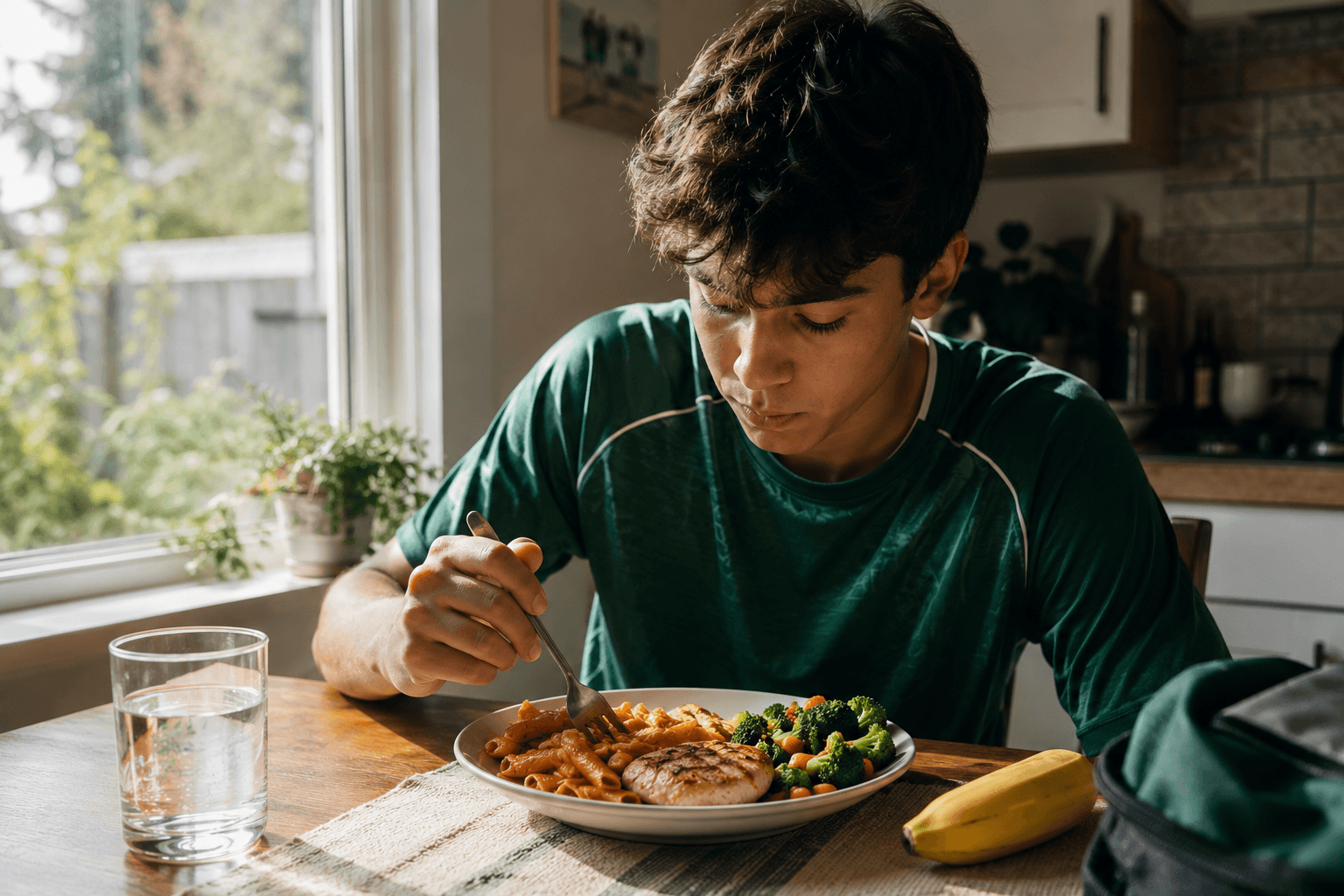
Pasta with light tomato sauce + grilled chicken or tofu + a side of cooked zucchini or carrots + sliced fruit + water. This is the gold standard for a reason, lower-fiber pasta digests well, the sauce keeps fat minimal, and the protein portion is right-sized.
The Rice Bowl:
White or brown rice + grilled chicken strips or canned salmon + steamed broccoli or edamame + orange slices + water. Works well for families who don’t do pasta. White rice actually digests slightly faster and can be a better choice for teens with sensitive stomachs on game day.
The Sandwich Build:
Turkey or chicken on whole-grain bread + lettuce and tomato + fruit cup + pretzels + water. Simple, portable, and easy for kids who aren’t hungry enough for a full hot meal. The pretzels add carbs and a little sodium, both useful for pre-game fueling.
The Burrito Bowl:
White rice + black beans or grilled chicken + salsa + a small amount of guacamole + corn + water. Go easy on the cheese and sour cream to keep fat in check. This is Liam’s favorite on home game days.
The Breakfast-for-Dinner Option (morning games):
Oatmeal made with milk + banana + scrambled eggs (2) + a drizzle of honey + water. Oats are one of the best pre-game carb sources, slow-digesting enough to sustain energy but gentle on the stomach.
For vegetarian athletes:
Pasta + white beans or lentil soup + roasted sweet potato + fruit + water. The beans provide protein and the sweet potato adds sustained carbohydrates. If dairy is tolerated, Greek yogurt on the side adds protein without heaviness.
What to Eat 30–60 Minutes Before the Game (The Top-Up Snack)
This is where a lot of parents make the opposite mistake from what Liam was making. They either skip this window entirely, leaving their teen slightly under-fueled going in, or they try to squeeze in another full snack that ends up sitting in the stomach.
The P30 snack is small, familiar, and mostly carbohydrate. That’s it.
The rules for the P30 window:
- One handheld portion, not a meal
- Low fiber, low fat, easy to digest
- Nothing new on game day, ever
- A few sips of water, not a full bottle
P30 snack options that work:
- Ripe banana (the riper the better, more easily digestible)
- Applesauce pouch or small cup
- Fig bar or soft granola bar (check labels, aim for lower fiber)
- Pretzels (small handful, about 8–12)
- Rice cake with a thin swipe of jam or honey
- Half a plain bagel with nothing or light honey
What to skip in this window:
Heavy nut butter portions, large amounts of cheese, any fried food, high-fiber energy bars marketed as “healthy,” or carbonated drinks. All of these will slow digestion at exactly the wrong moment.
If your teen gets nervous before games and loses their appetite: Applesauce is the most reliable option here. It goes down easily even when the stomach is tight with nerves, it digests quickly, and it delivers a meaningful carbohydrate hit without any fiber or fat to complicate things.
The Foods That Will Hurt Performance (Even the “Healthy” Ones)
This section matters because many of the foods parents instinctively reach for on game day are genuinely healthy choices, just not at this moment.
High-fiber foods too close to game time. Whole-grain crackers, raw vegetables, beans, and bran-heavy cereals are excellent foods. They’re also hard to digest under physical stress. For a pre-game meal within 2 hours, reach for the simpler versions, white rice over brown, white pasta over whole wheat, cooked vegetables over raw.
Large amounts of dairy. Full-fat yogurt, cheese-heavy meals, or a large glass of whole milk right before a game can cause that heavy, sluggish feeling mid-match. Dairy in moderate amounts is fine, a slice of cheese, a small yogurt, but a large dairy-forward meal close to game time is a risk.
High-fat protein sources. Bacon, sausage, fried chicken, or a big burger the morning of a game. The protein may seem performance-appropriate, but the fat content slows everything down. Lean protein sources like grilled chicken, turkey, eggs, or tofu work far better.
Energy drinks. Worth saying plainly: energy drinks are not appropriate for teen athletes. The caffeine spikes anxiety, the sugar causes a blood glucose crash mid-game, and the dehydration effect works directly against everything you’re trying to accomplish. Water and real food do the job better.
New foods on game day. The digestive system doesn’t like surprises. A food that works well during the week may cause unexpected cramping or nausea during game-time physical stress, simply because your teen’s body hasn’t practiced digesting it under those conditions. Practice nutrition on training days. Game day is never the time to experiment.
The Hydration Piece Most Parents Completely Miss
When I figured out what was happening with Liam’s second-half energy crash, I kept focusing on the food. It took me longer to understand that his hydration coming into games was also a problem.
He was drinking water, just not enough of it, and not early enough. By the time he got to the field, he was already mildly behind. And mild dehydration doesn’t feel dramatic. It doesn’t feel like anything, really, until it starts showing up as slower reaction time, heavier legs, and fuzzy decision-making in the second half.
Research shows that performance decreases measurably with just 1–2% body weight loss in fluids. For a 140-pound teen athlete, that’s about 1.5–2.5 pounds of sweat before the effect is noticeable.
The hydration timeline on game day:
Morning of the game: Start with water at breakfast. The goal is to arrive at the field already well-hydrated, not trying to catch up at the bench. 16–20 oz with the morning meal is a good target.
At the pre-game meal (3–4 hours out): Water with the meal. Not juice, not sports drink, not soda. Plain water.
30–60 minutes before (P30): A few good sips, about 6–8 oz. Not a full bottle. Chugging water in this window causes a sloshy, uncomfortable feeling during play.
During the game: Regular small sips every 15 minutes or so. More frequently in heat. The goal is to sip consistently throughout rather than gulping at halftime when the damage is already done.
Sports drinks, when they actually make sense: Water is the default for most pre-game windows. Sports drinks become useful for sessions lasting longer than 60–75 minutes, in hot or humid conditions, or when your teen is a heavy sweater (you’ll notice white salt marks on dark shirts, or eyes that sting from sweat). For most games under an hour in mild conditions, water is all they need.
The urine color check (it works): Teach your teen to check urine color before leaving for the game. Very pale yellow: well hydrated. Dark yellow: drink more before you go. This simple habit takes 10 seconds and tells you more than any hydration calculator.
Game Time Scenarios: Matching the Meal to the Schedule
One of the practical challenges of youth sports is that games don’t happen at the same time every week. Here’s how to apply the timing framework across the most common scenarios:
Early morning game (8:00–10:00 a.m.)
This is the hardest window because your teen may not be hungry yet and the timeline is compressed. Aim for 6:30–7:00 a.m.: Simple breakfast of oatmeal or toast + eggs + banana + water. Keep it light and familiar. If your teen really can’t eat early, a banana and a few sips of water 30 minutes before is better than nothing. Prioritize hydration the night before.
Midday game (12:00–1:00 p.m.)
Breakfast at 9:00 a.m: Eggs + toast + fruit + milk + water.
P30 at 11:30 a.m: Banana or applesauce + a few sips of water.
After-school game (4:00–6:00 p.m.)
Send your teen to school with a P1–3 snack for the afternoon, something balanced with carbs and protein, around 2:00–2:30 p.m. Then a P30 snack around 3:15–3:30 before they leave for the field.
P1–3 snack (2:15 p.m.): Yogurt + granola + fruit, or turkey and cheese on a small roll.
P30 snack (3:20 p.m.): Pretzels or banana + water.
Evening game (7:00 p.m. or later)
Dinner at 3:30 p.m: Rice or pasta + chicken + vegetables + fruit + water.
P30 at 6:15 p.m: Fig bar or applesauce pouch + water.
Tournament Days: The Between-Games Problem
If your teen plays in tournaments, multiple games in one day, the pre-game framework still applies, but you add the between-game layer.
Less than 30 minutes between games: Quick carbs only. An applesauce pouch, orange slices, a few chews, or pretzels. Skip anything with significant protein or fat, there’s not enough time to digest it.
30–60 minutes between games: Carbs with a small amount of protein. A fig bar and a few bites of a turkey wrap. A banana and a drinkable yogurt. Keep portions small.
More than 60 minutes between games: Treat this like a mini P1–3 window. A real snack with carbs, protein, and water. Half a sandwich + fruit + water. Yogurt + granola + grapes.
The golden rule for tournaments: pack a cooler from home. Concession stands are full of exactly the wrong foods for between-game fueling, fried, heavy, unfamiliar, and low in the carbohydrates your teen actually needs.
A Note on the Recovery Window (POST30)
Pre-game nutrition gets all the attention, but recovery nutrition is where the long-term improvements happen. Once the final whistle blows, your teen has about a 30-minute window where their muscles are most receptive to refueling.
The POST30 target is: carbohydrates + 20–30 grams of protein + fluids.
Chocolate milk hits all three and is genuinely one of the most research-supported recovery options available. It’s not a gimmick, the carbohydrate-to-protein ratio in chocolate milk closely matches what sports nutrition research identifies as optimal for glycogen replenishment and muscle repair after intense effort.
Other solid options:
- Greek yogurt + granola + banana
- Turkey sandwich (half) + water
- Smoothie (milk or soy milk + yogurt + fruit)
- Rice + grilled chicken + vegetables if they can manage a full meal
For Liam, making the POST30 snack a non-negotiable habit did more for his training week energy than almost anything else we changed.
The Pre-Game Meal Your Teen Will Actually Eat
All of this is only useful if your teen will actually eat it. And teenage athletes, especially before big games, can be hit or miss with appetite.
Let your teen choose from approved options, not from an open menu. Give them two or three pre-game meal choices that fit the framework and let them pick. They’re more likely to eat something they chose.
Keep game-day meals familiar. This is not the night to introduce a new recipe. Pre-game eating is comfort eating, your teen’s gut needs to trust the food. Whatever works on regular training days is what you serve on game day.
Practice the nutrition plan during the week. The P30 snack, the pre-game meal timing, the hydration habits, all of these should be practiced on training days, not debuted on Saturday morning. Liam spent a full week running the game-day routine before his first real game with the new approach. By game day it felt automatic.
Small portions are fine if appetite is low. A half-portion of the right foods is better than a full portion of the wrong ones, and far better than nothing. If your teen is too nervous to eat much, prioritize the carbohydrates and let the protein portion be smaller.
What Changed for Liam
The week his coach pulled me aside was the lowest point of that soccer season. Looking back, I understand it was also the turning point.
We didn’t overhaul everything at once. We started with one change at a time, first the pre-game plate (more rice, less protein powder), then the hydration routine (water at breakfast, water at lunch, water with the P30 snack), then the recovery window (chocolate milk in the car on the way home). Each change took about a week to feel normal.
By the sixth game of the second half of the season, Liam played a full ninety minutes. His coach subbed him out at minute eighty-eight, not because his energy was gone, but to give him a standing ovation moment. He came off the field red-faced and grinning.
That grin made every Saturday morning grocery run, every packed cooler, and every “Mom, do I have to eat the banana” conversation worth it.
Your teen has that in them too. Sometimes the fuel is the last piece of the puzzle.
Quick Reference: Pre-Game Meal Cheat Sheet
3–4 hours before the game:
- ½ plate carbs (pasta, rice, potatoes, bread, oats, fruit)
- ¼ plate lean protein (chicken, turkey, eggs, tofu, beans)
- ¼ plate gentle vegetables or fruit
- Small healthy fat (olive oil, avocado, keep light)
- Water
30–60 minutes before the game:
- Banana, applesauce, fig bar, pretzels, or rice cake + jam
- A few sips of water
- Nothing new, nothing heavy
Avoid before games:
- Fried foods
- High-fat meals
- Very high-fiber foods
- Large dairy portions
- Energy drinks
- New foods
Hydration targets:
- Morning of game: 16–20 oz water with breakfast
- At pre-game meal: water with food
- P30 window: 6–8 oz sips
- During play: small sips every 15 minutes
- After game: drink until urine is light yellow
Want the Full Week of Game-Day Fueling Mapped Out?
If you found this helpful, the free 1-week meal plan at Raising Strong Athletes maps out a complete week of eating for a teen athlete, including training days, rest days, and a game-day schedule you can print and put on the fridge. It takes the guesswork out of the week entirely.
And if you want the complete system, every timing window, 100 snack ideas, hydration targets, recovery habits, tournament planning, and allergy-friendly swaps all in one place, the Raising Strong Athletes ebook was built exactly for this. It’s the guide I built after that parking lot conversation, and it’s everything I wish I’d had from the star
Frequently Asked Questions
What should a teen athlete eat before a game?
A teen athlete should eat a balanced meal 2 to 3 hours before a game containing carbohydrates for energy, lean protein for muscle support, and a small amount of healthy fat. Good options include pasta with chicken, rice with turkey, or oatmeal with eggs. Avoid high-fat, high-fiber, or unfamiliar foods that can cause stomach discomfort during play.
How long before a game should a teen athlete eat?
The ideal timing is 2 to 3 hours before game time for a full meal, 1 to 2 hours for a light snack, and 30 minutes before for a quick carbohydrate boost like a banana or honey. Eating too close to game time can cause cramping and sluggishness.
What foods should teen athletes avoid before a game?
Teen athletes should avoid fried or fatty foods, high-fiber vegetables like broccoli and beans, spicy foods, carbonated drinks, and anything they have never eaten before game day. These foods slow digestion and can cause stomach discomfort during competition.
Is pasta a good pre-game meal for teen athletes?
Yes, pasta is one of the best pre-game meals for teen athletes. It is high in carbohydrates which fuel working muscles, easy to digest, and familiar to most athletes. Pair it with a lean protein like chicken or turkey and a light tomato sauce for a complete pre-game meal.
What is a good pre-game snack for teen athletes with no appetite?
Athletes with pre-game nerves often struggle to eat. Liquid options work best, a banana smoothie, chocolate milk, or a small fruit and yogurt blend provides carbohydrates and protein without feeling heavy. A banana with honey is another quick option that is easy on the stomach.
Want game day handled without the scramble? Grab the free Game-Day Survival Kit: 8 print-ready checklists for food timing, coolers, road trips, team snacks, and more.

Maya Bennett is a youth sports parent and nutrition
advocate with over 8 years of experience supporting
teen athletes. After helping her own son overcome
chronic fatigue and performance struggles through
better fueling habits, she founded Raising Strong
Athletes to give other parents the practical,
science-backed roadmap she wished she’d had.
Maya’s content is grounded in established sports
nutrition research and real-world family experience.