
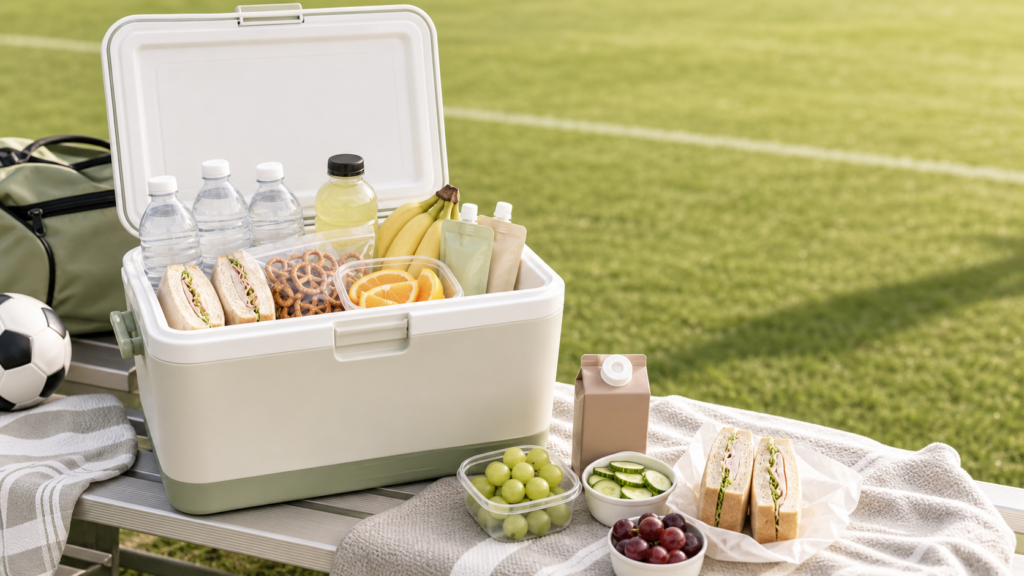
It’s 7:40 in the morning, you’re already on your second coffee, and your kid has three more games before this thing is over. By the afternoon match, they’re dragging. The concession stand has nachos, blue slushies, and a sad pretzel. You watch your athlete play the late game on fumes and a sugar crash, and you think: there has to be a better way to do this.
There is. And most of it fits in a cooler.
A single game is easy to fuel. One pre-game meal, one snack, done. An all-day tournament is a different animal. Your teen has to play, recover, and play again, sometimes four or five times, with breaks that range from twenty minutes to three hours. What goes in the cooler the night before decides whether they finish strong or fall apart by the third game.
Here’s how to pack it.
Want to skip straight to the list? There’s a free print-and-pack checklist further down, grab it and go.
Why a tournament wrecks a teen's energy
During hard exercise, your teen’s muscles burn through stored carbohydrate (glycogen) fast. One game dents those stores. A full day of games drains them. If they’re not topping the tank back up between matches, every game starts a little lower than the last one. That’s the afternoon crash you’re watching from the sideline.
Two other things make tournament days harder than they look. Blood gets pulled away from the stomach toward the working muscles, so heavy or greasy food sits there and turns into cramps. And teens sweat out more fluid and sodium across a long, hot day than most parents expect, which shows up as fatigue, headaches, and that “I just feel off” complaint.
The fix isn’t complicated. Steady carbs, light protein, real fluids, and timing that matches the length of the break. (If you want the bigger picture beyond tournament days, start with our complete nutrition guide for teen athletes.
The tournament fueling timeline
Eating at a tournament is mostly about when, not just what. Here’s the rhythm:
| When | What to aim for | Examples |
|---|---|---|
| Breakfast (3–4 hrs before first game) | A real meal: carbs + some protein, low grease | Oatmeal with banana and peanut butter; eggs and toast; bagel with turkey |
| 1–2 hrs before a game | A mini-meal or larger snack, easy to digest | Turkey sandwich on white bread; yogurt and granola; fruit and crackers |
| Less than 1 hr between games | Quick carbs, low fat and fiber | Banana, pretzels, applesauce pouch, white bagel with jam |
| 2+ hrs between games | A small balanced meal | Sandwich, fruit, and a drink, like a mid-morning lunch |
| After the last game | Carbs + protein to recover | Chocolate milk, a sandwich, yogurt with fruit |
The single most useful idea here: short break, small and simple. Long break, more like a meal. Don’t hand a kid a full lunch fifteen minutes before they take the field, and don’t expect a banana to carry them through a two-hour gap.
Short breaks: under an hour between games
This is where parents get it wrong most often. With a short break, the goal is fast, gentle fuel that won’t slosh around or cramp them up. Keep it to easy carbs with very little fat, protein, or fiber, because those slow digestion right when you don’t want it slowed.
Good short-break picks:
– Banana or orange slices
– Pretzels or saltine-style crackers
– White bagel or white bread with a little jam
– Applesauce or a fruit pouch
– A few graham crackers
– A small handful of dried fruit
If your teen has no appetite between games (nerves do this), a sports drink or a few sips of juice still gets carbs in without making them eat. Something is better than nothing.
Need a bigger menu to pull from? Our list of 100 healthy snacks for teen athletes has options for every part of the day, including more tournament picks.
Long breaks: two hours or more
A longer gap is your chance to feed them an actual mini-meal. Now you can add protein and a bit more substance, because there’s time to digest before the next game.
Good long-break picks:
– Turkey or ham sandwich on regular bread
– Pasta salad with a little chicken
– Rice bowl with chicken and a mild veggie
– Cheese, crackers, and fruit
– A wrap with deli meat and not much else
Keep it familiar. A tournament is the worst possible time to introduce a new food and find out it doesn’t sit well. Whatever you pack, your athlete should have eaten it before, on an ordinary practice day, with no surprises.
Hydration for a long, hot day
Water is the foundation, and most teens show up already a little behind. Have them sip throughout the day instead of chugging once they feel thirsty, because thirst means they’re already low.
For a long day, especially in the heat or for games over an hour, a sports drink earns its place. It replaces the sodium they’re sweating out and adds a little quick carbohydrate. You don’t need anything fancy or expensive. The cheap classic sports drinks do the job. Salty snacks like pretzels also help replace sodium and nudge them to keep drinking.
One quick gut-check: pale yellow urine means they’re doing fine. Dark means catch up on fluids. It’s a low-tech check that actually works. (For how much your teen actually needs across a full day, see our hydration guide.)
A note on energy drinks: skip them. They’re built on marketing, not on what a 14-year-old’s heart needs during a tournament, and the caffeine crash is real.
After the last game (and day two)
When the day is done, the priority shifts to recovery: carbs to refill those drained stores, plus some protein to repair muscle. This matters double if there’s a second day of the tournament tomorrow. (We go deep on this in our post-game recovery guide.)
Easy recovery options: chocolate milk (genuinely one of the best, cheapest recovery drinks there is), a sandwich, or yogurt with fruit. Aim to get something in within an hour or two of the final game, then a normal dinner later.
If it’s a two-day tournament, don’t let them coast on concession food and call it a day. Tomorrow’s energy is built on tonight’s dinner.
When it's your turn for team snacks
If you’re on snack duty for the whole team, you’re solving a different problem: feed twenty-plus kids, travel it in a cooler, and don’t trip over anyone’s allergy.
Safe, shareable, allergy-aware picks:
– Orange slices and grapes (hydrating, nearly universal, no allergens)
– Pretzels (nut-free, easy to portion)
– Individual applesauce or fruit pouches
– Sunflower-seed butter sandwiches as a nut-free swap for PB&J
– Sports drink pouches or water for hot days
When in doubt, go with whole foods and individually wrapped items. They’re faster to hand out and easier to keep clean at an outdoor field. And always check with your team coordinator about allergies before you shop, not after.
For the full playbook on feeding the whole team, including how much to buy by team size, see Team Snack Duty for Teen Athletes.
Cooler packing and food safety
A cooler full of warm sandwiches helps no one. Perishable food (deli meat, yogurt, cut fruit) needs to stay cold, under about 40°F, across the whole day.
A few tricks that make the morning easier:
– Freeze a couple of water bottles the night before. They keep the cooler cold and turn into drinking water as they thaw.
– Pack in the order you’ll eat. Breakfast and early snacks on top, recovery food at the bottom.
– Use a separate small bag for the “between games” quick snacks so you’re not digging through the whole cooler during a four-minute window.
Mistakes to avoid
– Greasy fast food before or during. Burgers and fries are the classic culprit for mid-game stomach cramps. Save them for the celebration after.
– Loading up on sugar for “energy.” Candy and soda give a fast spike and a faster crash. Steady carbs beat sugar bombs.
– Trying new food on tournament day. Test everything on a practice day first.
– Waiting until they’re thirsty to drink. By then they’re already behind.
– Relying on the concession stand. Assume it’ll have nothing useful and pack like it.
– Feeding a full meal right before a game. Match the food to the length of the break.
When to check with a professional
This is general fueling guidance for healthy teen athletes, and needs really do vary by age, body size, sport, intensity, and how hot the day is. A 13-year-old in a one-hour event and a 17-year-old playing a five-game soccer tournament are not the same.
Loop in your pediatrician or a registered sports dietitian if your athlete has food allergies or a medical condition, if they regularly struggle to eat enough to keep up with their training, or if stomach problems keep happening no matter what you pack. A pro can tailor a plan to your specific kid in a way no blog post can.
FAQ
What should a teen athlete eat between games?
It depends on the break. Under an hour: quick carbs that are easy on the stomach, like a banana, pretzels, or applesauce. Two hours or more: a small balanced meal with some protein, like a turkey sandwich and fruit.
What are the best snacks to pack for an all-day tournament?
A mix. Quick-energy carbs (bananas, pretzels, crackers, fruit pouches) for short breaks, mini-meal options (sandwiches, pasta salad) for long breaks, plenty of water and a sports drink for the heat, and a recovery snack like chocolate milk for after.
What if there are only 30 minutes between games?
Keep it tiny and simple. A few bites of a banana, a handful of pretzels, or a few sips of a sports drink. If nerves kill their appetite, the drink alone still gives them usable carbs.
What foods should they avoid during a tournament?
Anything greasy, very high in fat, or very high in fiber close to game time, since those digest slowly and cause cramps. That means fast food, heavy meals, and big servings of raw veggies or beans right before playing. Skip energy drinks entirely.
How much should my teen drink during a long day?
Sip steadily all day rather than waiting for thirst. Add a sports drink for hot conditions or games over an hour. Pale yellow urine is the easy sign they’re keeping up.
Can they just eat from the concession stand?
Treat it as a backup, not a plan. Most stands lean toward fried, sugary food that works against steady energy. Pack your own and you control the whole day.
Grab the free Sports Parent Fuel Kit
The hardest part is remembering it all at 6am when you’re half awake and looking for car keys. So I made you the lists. The free Sports Parent Fuel Kit has 8 print-ready checklists: tournament food, the 3-layer cooler map, away-game road food, snack duty, budget groceries, fast breakfasts, and a sports bag list. Print the ones you need, stick them on the fridge, and stop packing from memory.

Maya Bennett is a youth sports parent and nutrition
advocate with over 8 years of experience supporting
teen athletes. After helping her own son overcome
chronic fatigue and performance struggles through
better fueling habits, she founded Raising Strong
Athletes to give other parents the practical,
science-backed roadmap she wished she’d had.
Maya’s content is grounded in established sports
nutrition research and real-world family experience.