
Most sports parents focus on what happens before the game. The pre-game meal, the warm-up snack, the water bottle in the bag. That part gets a lot of attention.
What happens after? Usually a drive-through on the way home and a teenager glued to their phone until midnight.
Here’s the thing nobody tells you: the 45 minutes after a game are the most important nutrition window of the entire week. Miss it and the hard work your teen put in on that field starts to go to waste. Hit it right and they recover faster, sleep better, and show up stronger for next weekend.
This is the full recovery system, after game days, after practice, and everything in between. Every recommendation here comes from peer-reviewed research, translated into things you can actually do on a Saturday night when everyone is exhausted and nobody wants to cook.
Why Recovery Is a System, Not a Single Meal
When your teen athlete competes hard, three things happen inside their body at once.
Muscle fibers get damaged. Intense exercise creates microscopic tears in muscle tissue. This sounds alarming but it is completely normal, it is how muscles grow stronger. Those tears need the right raw materials to repair properly. Without them, your athlete goes into next week’s training on a body that hasn’t finished fixing itself from this week.
Energy stores get depleted. Muscles run on glycogen, stored carbohydrate. After a competitive game, especially one lasting 60-90 minutes, those stores can drop significantly. Research confirms that carbohydrate intake is essential for glycogen replenishment, especially within the initial hours after exercise.
Fluid and electrolytes are lost through sweat. This one surprises parents most. A 2025 systematic review found that among young athletes, 81% of studies reported dehydration during competition, meaning most teen athletes cross the finish line already behind on fluids before recovery even starts.
A proper recovery system addresses all three. And it starts the moment the final whistle blows.
Related: What to Feed Your Teen Athlete Before a Game, Pre-Game Meal Timing Guide
This is where most sports parents drop the ball, not because they don’t care, but because nobody told them this window exists.
In the 45 minutes immediately after intense exercise, your teen’s muscles are primed to absorb nutrients more efficiently than at any other point in the day. Enzymes responsible for glycogen synthesis are highly active. Muscle cell membranes are more permeable to glucose. The body is essentially holding the door open – and what you put in during that window matters far more than what you eat two hours later.
What goes in that window: carbohydrates and protein together.
Research consistently shows that combining both nutrients outperforms either alone for recovery. The carbohydrates kickstart glycogen replenishment. The protein delivers amino acids to damaged muscle fibers.
The easiest options that actually work:
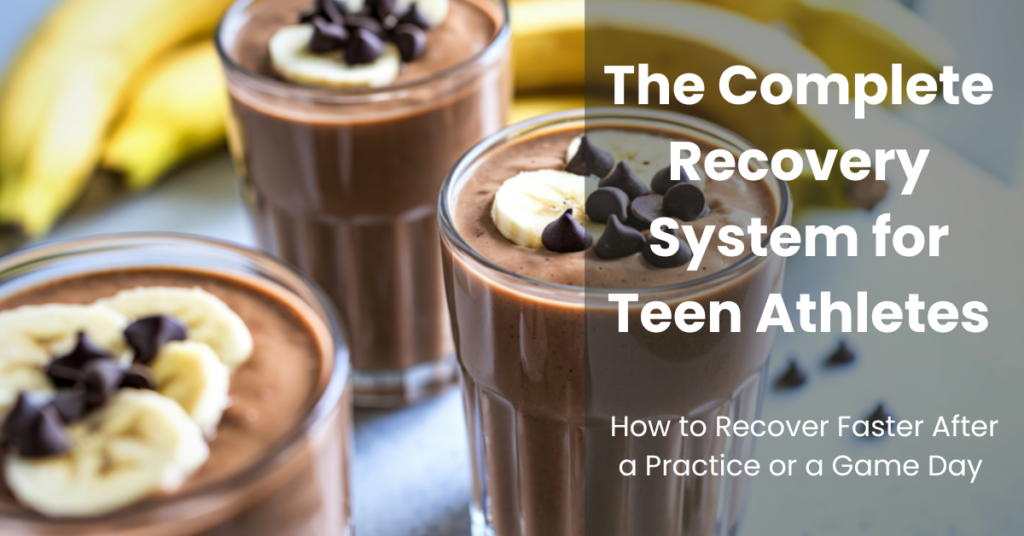
Chocolate milk: this is not a sugar drink. It delivers an ideal carbohydrate-to-protein ratio for post-game recovery, plus fluid and electrolytes. One 12-ounce glass covers most of the bases. Research at CHOC also notes that tart cherry juice, consumed within 30 minutes after activity, has anti-inflammatory properties that can reduce immediate and delayed muscle soreness and stiffness
Banana + peanut butter: fast-absorbing carbs with healthy fat and a hit of protein
Greek yogurt + fruit: protein plus carbohydrates plus antioxidants
Turkey sandwich on whole grain: if they’re hungry enough, this covers everything
Smoothie (milk + banana + oats): ideal when appetite is low after a hard game
What about appetite? Many teen athletes feel nauseous or completely uninterested in food right after intense competition. Adrenaline suppresses appetite. If your teen won’t eat solid food, start with the liquid option – chocolate milk or a smoothie – and offer something more substantial once the appetite comes back, within that 45-minute window.
Want the full list of recovery foods? The Teen Athlete Nutrition Toolkit, includes 100+ snack ideas organized by timing – pre-game, post-game, travel, and school.
Part 2: Rehydration: More Urgent Than Most Parents Realize
Fluid replacement after a game is not optional. It is structural recovery.
Here is a practical rule from UChicago Medicine’s pediatric team: take your teen’s body weight in pounds, divide it in half, and that number in ounces is their baseline daily water goal. On game days, they need significantly more on top of that.
A simpler real-world guide: urine color. Before bed, your teen’s urine should be pale yellow. Dark yellow or amber means they are still dehydrated and recovery is being compromised while they sleep.
What to drink:
– Water is always the foundation
– For tournaments, hot weather games, or back-to-back games: add electrolytes. Research published in Nutrients found that both oral rehydration solutions and sports drinks promoted significantly greater rehydration than water alone after intense exercise
– Coconut water works well as a natural electrolyte option many teen athletes tolerate
– Milk-based beverages have also shown recovery benefits in research – another reason chocolate milk earns its reputation
What to avoid post-game:
Energy drinks. Sodas. Excessive sports drinks beyond the recovery window. CHOC’s pediatric sports medicine team recommends limiting sugar-filled sports drinks to the immediate post-exercise period – they serve a real purpose in the first 45 minutes, but after that, water and whole food take over.
Part 3: The Recovery Meal: 1 to 2 Hours After the Game
The immediate post-game snack handles the urgent window. This meal handles the longer recovery arc – the muscle repair and glycogen restoration that continues for hours after competition.
The recovery plate formula:
– Half the plate: carbohydrates: rice, pasta, potatoes, bread. These replenish depleted glycogen stores. Whole grain pasta, potatoes, rice, and beans are among the recommended carbohydrate sources for teen athlete recovery meals
– Quarter of the plate: lean protein: chicken, fish, eggs, turkey, legumes. Research on adolescent athletes confirms they require 1.2 to 2.0 grams of protein per kilogram of body weight per day, depending on sport type and training intensity
– Quarter of the plate: vegetables and fruit: micronutrients and antioxidants that reduce inflammation and support tissue repair. Berries and cherries are particularly good sources of natural anti-inflammatories for athletes
Recovery dinner ideas that work for real sports families:
– Grilled chicken + white rice + steamed broccoli with olive oil
– Pasta with lean ground beef and tomato sauce + side salad
– Salmon + sweet potato + green beans
– Homemade burger on whole grain bun + sweet potato fries
– Steak fajitas with sautéed peppers, whole grain tortillas, black beans, and rice
One note from Avance Care’s nutrition team: rather than stopping at a fast food restaurant after games, organizing a team potluck or having a simple home-cooked meal ensures balanced choices at the exact time they matter most. Hard to argue with that.
Part 4: Sleep: The Recovery Tool Nobody Talks About
I’ll be honest: this is the part of teen athlete recovery that most parents underestimate the most. Including me, for longer than I’d like to admit.
And yet, research shows adolescent athletes average around 6.3 hours of sleep – far below the recommended 8 to 10 hours for their age group. The gap between what they need and what they get is enormous.
The consequences are concrete. Athletes sleeping fewer than 8 hours per night were 1.7 times more likely to be injured than those who got adequate rest. Beyond injury risk, sleep deprivation decreases protein synthesis and increases protein degradation, directly impairing muscle recovery. In plain terms: your teen can eat perfectly and still under-recover if their sleep is short.
After a Saturday game, here is how to protect sleep:
– Screens off one hour before bed. Blue light from phones and tablets suppresses melatonin, the hormone that regulates the sleep-wake cycle. After a high-adrenaline game, this matters more than usual – the nervous system is already activated
– Keep the room cool and dark. Body temperature naturally drops during deep sleep and a cool room helps that process along
– Aim for 9 hours on game nights. Not a luxury – biological necessity
– Consistent bedtime matters more than perfect bedtime. Shifting sleep by more than an hour disrupts the sleep cycle. Even if they can’t get 9 hours, keeping the schedule consistent helps the quality of whatever sleep they do get
Part 5: The Morning After a Game
Sunday morning after Saturday’s game is not a blank slate. The body is still in active repair mode and what happens in the next few hours either supports or stalls that process.
Do not skip breakfast.
After 8-9 hours of overnight fasting, glycogen stores are depleted again. A proper breakfast restarts the recovery process. Nemours pediatric nutrition specialists emphasize that teen athletes should never skip meals – each missed meal is a missed opportunity to fuel recovery.
Best morning-after breakfasts:
– Oatmeal + banana + boiled or scrambled eggs
– Whole grain toast + eggs + orange juice
– Smoothie with oat milk + banana + frozen berries + Greek yogurt + oats
– Pancakes + eggs + fruit – yes, even pancakes work here, especially after an intense tournament
Gentle movement – not complete rest.
This surprises a lot of parents. Light walking, gentle stretching, or a short easy bike ride on Sunday morning actually speeds up recovery by increasing blood flow to sore muscles. Complete stillness can increase stiffness. Think 15-20 minutes of easy movement, not another training session.
Hydration continues.
Start Sunday morning with a large glass of water before anything else. The body continues rehydrating through the night and morning hydration finishes the job.
Related: Is Your Teen Athlete Drinking Enough Water? The Signs Most Sports Parents Miss (https://raisingstrongathletes.com/hydration-guide)
Part 6: After Practice: How It Differs From Game Day
Practice recovery follows the same principles as game day recovery, but two things change:
Intensity is usually lower. A technical session, skills training, or a shorter practice depletes less glycogen and causes less muscle damage than a full competitive game. The recovery response can be proportionally lighter.
The timeline is tighter. Practice on a Tuesday night means your teen needs to eat, recover, do homework, and still protect their sleep – all before 10pm. Efficiency matters more than precision.
The 3-Step After-Practice System
Step 1: Recovery snack within 30 minutes
Smaller than a game day recovery meal, same principle – carbs and protein together.
– Apple + peanut butter + glass of milk
– Cheese + crackers + fruit
– Greek yogurt + granola + berries
– Smoothie – banana + milk + oats
– Rice cakes + almond butter + grapes
One practical shortcut: If dinner is happening within 45 minutes of getting home from practice, skip the snack and go straight to a proper dinner. The window is not rigid – what matters is getting the nutrients in, not hitting an exact minute.
Step 2: Dinner within 1 to 2 hours
Same recovery plate formula – carbohydrates, protein, vegetables. Portions can be slightly smaller on lighter practice days versus heavy scrimmage sessions. A balanced meal of whole-grain pasta with meat sauce, whole-grain bread, and a side salad is an excellent post-practice dinner option.
Step 3: Protect sleep on school nights
This is where most teen athletes lose their recovery gains. A 7pm practice, homework until 10pm, and phone scrolling until midnight leaves 6 hours of sleep on a night when the body needs 9.
Practical steps that actually work:
– Phone charger lives outside the bedroom on practice nights – non-negotiable
– Homework starts immediately after the recovery snack, not after scrolling
– A warm shower after practice helps the nervous system transition from activated to rest mode
– Target lights out by 9:30-10pm for a 6:30am wake-up
The Complete Recovery Checklist
Print this. Put it on the fridge. Use it every game weekend
After Every Game
 Recovery snack or drink within 45 minutes (carbs + protein) Rehydrate with water or electrolytes – pale yellow urine before bed Full recovery meal within 1-2 hours (half carbs, quarter protein, quarter veg) Screens off 1 hour before bed 9 hours of sleep Easy movement Sunday morning – 15-20 minutes, not training Proper breakfast before anything else Sunday morning Continue hydrating all Sunday
After Every Practice
Recovery snack within 30 minutes OR go straight to dinner within 45 minutes Balanced dinner: carbs, protein, vegetables Water throughout the evening Phone charger outside bedroom Lights out by 9:30-10pm
The Bottom Line
Recovery is not passive. It does not just happen because your teen sat on the couch for an hour.
It happens because the right food arrived in the right window. Because the body was rehydrated before bed. Because 9 hours of sleep gave the muscles time to rebuild. It is a system, and every piece of that system is simple, cheap, and completely within reach.
You are already doing the hard part. The driving, the cheering, the 7am Saturday wake-ups, the late drives home. The recovery system is just the last step that makes all of it count.
Ready to Build the Full System?
The Teen Athlete Nutrition Bundle includes:
– The complete Teen Athlete Nutrition eBook – game day fueling, hydration, recovery, and growth nutrition
– The printable Nutrition Toolkit – weekly meal planner, grocery list, pre-game fuel guide, snack ideas, and hydration tracker
Everything a sports parent needs to stop guessing and start fueling. Instant download, use it this weekend.
Sources & Further Reading
Cornish & Barnes (2024). Nutrition and muscle recovery after exercise. Frontiers in Sports and Active Living. https://www.ncbi.nlm.nih.gov/pmc/articles/PMC11074447/
Naderi et al. (2025). Nutritional strategies to improve post-exercise recovery and subsequent exercise performance. Sports Medicine. https://pubmed.ncbi.nlm.nih.gov/40221559/
Wang, Meng & Su (2024). From food supplements to functional foods: emerging perspectives on post-exercise recovery nutrition. Nutrients. https://www.ncbi.nlm.nih.gov/pmc/articles/PMC11643565/
Sleep, nutrition, and injury risk in adolescent athletes: a narrative review (2023). PMC/NCBI. https://pmc.ncbi.nlm.nih.gov/articles/PMC10745648/
Connecticut Children’s Hospital (2024). Why sleep might be the most important part of your athlete’s training. https://www.connecticutchildrens.org/growing-healthy/why-sleep-might-be-most-important-part-your-athletes-training/
CHOC Children’s Health Hub (2024). An ultimate guide to child and teen athlete fuel and hydration. https://health.choc.org/an-ultimate-guide-to-child-teen-athlete-fuel-and-hydration/
Protein intake in adolescent athletes (2025). European Journal of Physical Education and Sport Science. https://efsupit.ro/images/stories/april2025/Art%2083.pdf
Ly, Hamstra-Wright & Horswill (2023). Post-exercise rehydration in athletes: effects of sodium and carbohydrate in commercial hydration beverages. Nutrients. https://www.ncbi.nlm.nih.gov/pmc/articles/PMC10674530/
UChicago Medicine. What young athletes should eat before and after the game. https://www.uchicagomedicine.org/forefront/pediatrics-articles/what-young-athletes-should-eat-before-and-after-the-game
Nemours Blog (2026). Nutrition, hydration and recovery for young athletes. https://blog.nemours.org/2026/01/young-athlete-nutrition/
Avance Care. Fueling your adolescent athlete. https://www.avancecare.com/fueling-adolescent-athlete/
Children and adolescents urine hydration indices systematic review (2025). PMC/NCBI. https://pmc.ncbi.nlm.nih.gov/articles/PMC11854905/

Maya Bennett is a youth sports parent and nutrition
advocate with over 8 years of experience supporting
teen athletes. After helping her own son overcome
chronic fatigue and performance struggles through
better fueling habits, she founded Raising Strong
Athletes to give other parents the practical,
science-backed roadmap she wished she’d had.
Maya’s content is grounded in established sports
nutrition research and real-world family experience.